How to Read the Rows for 100m
A breadboard is a solderless construction base used for developing an electronic circuit and wiring for projects with microcontroller boards like Arduino. As mutual every bit it seems, it may exist daunting when first getting started with using one.
Hence, with today's breadboard tutorial, I'll be guiding you on how to employ a breadboard, alongside establishing a connection with Arduino.
Earlier we become started with today's tutorial, let'south learn more about breadboard, its history, and the types available.
History of Breadboard
-

Breadboard in the past -

Current Solderless Breadboard
The term "Breadboard" comes from a literal slice of woods used to cut breadstuff, which back in the early on days, people would build electronic circuits on it. A typical circuit is as seen in the picture above.
Nevertheless, with the years of evolution comes design changes. At present, thanks to the invention by Ronald J. Portugal, the breadboard we know comes in a smaller, more than portable white plastic and pluggable pattern.
What are the types of breadboards?

We've seen the blazon of breadboard originating in the past, but for the modern-solar day solderless breadboard, it comes in different types; full-sized, Total+, half-sized, One-half+, and mini.
- With the size difference, at that place may be variances in how the different rows and columns of wire strips are continued though the general principle should remain the same
- Although the main departure comes in size, there are different shapes and colour options available likewise.
How is a Breadboard constructed?
When yous offset lay your hands on a breadboard, you'll find that in that location are many pinholes and kickoff to wonder how do I start connecting things? However, before you go started, y'all'll demand to understand the components of a breadboard to avert misusage.
Hence, I've cleaved downward the breadboard components and features for easier agreement!
1. Passenger vehicle and Terminal Strips
A breadboard consists of 2 areas called strips, and are ofttimes separated from the center portion (commonly known as ravine).
- Bus strips are mainly used for power supply connections
- Terminal strips are mainly used for electrical components
- Each strip consist of 5 pinholes, indicating that you only can connect up to five components in 1 particular section
Note: Although each row has 10 pinholes, you can only connect 5 components as the ravine isolates both sides of a given row. This isolation restricts electrical connection between both sides.
How to wire a breadboard
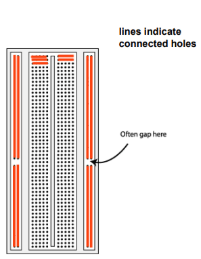
Notation how the holes coloured in orange are connected together. These sets of connecting holes can be called a node, where it's possible to interconnect the node from bus strips to terminal strips with jumper wires!
ii. Metallic clips
-

Transparent breaboard with metal clips visual -

Metal clips when removed
Next, are metal clips; metal clips are what that goes underneath the bus and last strips and can be seen when a breadboard is either taken apart or has a transparent outer layer. The function of these metal clips is to grab onto an electronic component when it's plugged into the pinhole. They are spaced 2.54mm apart as well.
*Which electronic component tin you utilize?
- So long as an electronic component has leads or pins, it tin exist used with a breadboard
- Leads: Long metal legs protruding out the component
- Pins: Shorter metal legs
three. How to read breadboard Row and Columns?
Now that nosotros've talked about the breadboard pin functions and what goes underneath it. Its time to explain the labeling on information technology.
You may accept spotted the numbering, letters, and signage written on a breadboard. These are written to help y'all locate the individual hole in the breadboard, similarly to how finding a cell in an Excel spreadsheet works.
- The example as seen above: Pigsty C12 = Column C, Row 12
What do the "+" and "-" signs mean? Breadboard Power Rails

Numbering and letters aside, the positive and negative signs on both sides of the breadboard are power rails, used to power your circuit past connecting battery pack or external power supply.
There'south no physical difference between positive and negative buses, where labeling is simply for reference and improve organization of circuits.
Power rail connexion
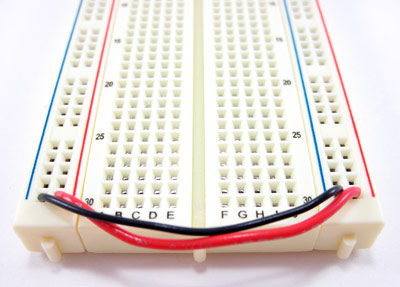
Notwithstanding, as ability rails on either side are not connected, you'll need to connect both sides with jumper wires to establish the same power source on both sides.
- Ensure that you connect the positive cease on i side to the positive finish on the other, negative side on one side to the other
iv. Other features of a breadboard
The above components of a breadboard are ones commonly seen, withal, there're other features plant in unique breadboards like such:
The higher up Grove – Breadboard has a unique characteristic non seen in regular breadboards and that'southward an integrated printed excursion board (PCB)!
With our onboard Grove connector, you'll exist able to build your very own Grove – module.
Its Features include:
- On-board Grove port to enable plug-and-play connectivity
- On-board Dupont connector for easy prototyping
- On-lath resettable fuse (PTC) for protection: 500mA max current
- On-board Power LED to show the working status
- Standard Grove size: 40*60mm
If you're interested to find out more on this breadboard, you can caput to our product page!
How to ability a breadboard?
When information technology comes to powering a breadboard, in that location are plenty of ways in doing so. I'll be recommending the about mutual ones seen below:
ane. Powering a breadboard through Arduino
If you're an avid Arduino user, this method would be the simplest for you! Since the Arduino already gets its power from a reckoner or external power supply, you can just ability a breadboard from "borrowing" its power supply.
Here's how to power your breadboard through Arduino:
- Connect Arduino GND pivot with female headers to the breadboard power rails
- Red wire from the header to the breadboard (+) ability rail
- Black wire from the Arduino GND to the breadboard (-) ability rail
2. How to connect a battery to a breadboard
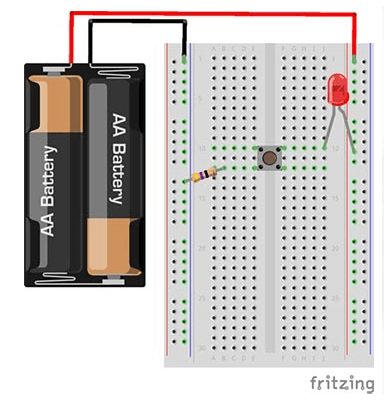
The second way you lot can power a breadboard is of course, through a battery! With reference to the higher up breadboard diagram, yous tin can just connect a bombardment to a breadboard by:
- Connect the battery pack ruby-red wire to (+) bus
- Connect the battery pack black wire to (-) coach
3. Powering a breadboard through a dedicated power supply
-

5V&3.3V breadboard power supply -

Similarly to other electronic components, you can ability the breadboard directly through our power supply adapter. This 5V&3.3V breadboard power supply includes a micro-USB port and power jack port, allowing the taking of direct power from a DC wall wart and outputting it in 5V and 3.3V regulated voltage!
Notation: There are indeed other power supply methods such as binding posts and benchtop. However, these methods are just applicable in certain breadboards and are less usually used compared to the in a higher place 3 ways.
Quick breadboard powering tip!
A general breadboard can handle a ability of 5V at 1A but it's recommended to continue information technology below 0.5A/500mA for condom purposes
- Power limits may vary depending on the type of breadboard and its manufacturer. Practice check the datasheet/specifications of the breadboard before purchasing one!
How to build a simple breadboard circuit?
Earlier nosotros understood the principle of breadboard merely at present comes to the part where y'all first building your commencement breadboard excursion! I've provided a tutorial for both beginners and Arduino users to endeavor!
Establishing a breadboard circuit connexion
Before we motion on to an actual breadboard circuit tutorial with LED, hither are three crucial steps you need to offset know in establishing a breadboard circuit connection with resistors and power supply
- Step 1: Connect ane of the power supply terminals to a hole of whatever section on the breadboard
- Step 2: Connect 1 concluding of a resistor to the hole of that section such that both devices are connected to each other
- Step 3: Take another resistor and connect information technology to the hole of some other section. Connect the 2nd power supply terminal to that same hole
Breadboard circuit tutorial
Now that you've understood how to institute a simple breadboard excursion connexion, hither'southward a tutorial to help you get started with edifice a breadboard circuit with LEDs!
The easiest way to go started with building a breadboard circuit is past following a breadboard diagram. Hither'southward what yous need:
- 1 A resistor from our resistor pack
- 1 5mm LED
- A Bombardment pack or a battery example with 2 AA batteries
- 1 Pushbutton
- Pace 1: Connect the battery pack carmine atomic number 82 wire to the (+) bus
- Stride two: Connect the battery pack black pb wire to the (-) charabanc
- Step three: Connect the resistor from hole B12 to the (-) bus
- Pace 4: Insert the four pins on a pushbutton into holes E10, F10, E12, and F12
- Step five: Insert the LED long lead into the (+) bus and the brusk lead to J10 hole
An Electric circuit should now be formed, with the LED lighting up.
Note: Y'all can completely rearrange the layout of the circuit but following the breadboard diagram exactly is the easiest manner to get started with building a breadboard circuit.
Bonus! Want to build a breadboard excursion without buying a physical product?
If you wish to learn and build your own circuits without buying an actual breadboard, you can use Fritzing, a free software program assuasive yous to build a breadboard circuit without physically getting one!
Likewise, if you are looking to acquire electronics, design and build circuits, become for Electronics tutorials for self-learning and they accept compiled a listing of best resource that tin help with your learning.
How to build a breadboard circuit with Arduino?
Arduino Breadboard Tutorial with LED and Water Level Sensor
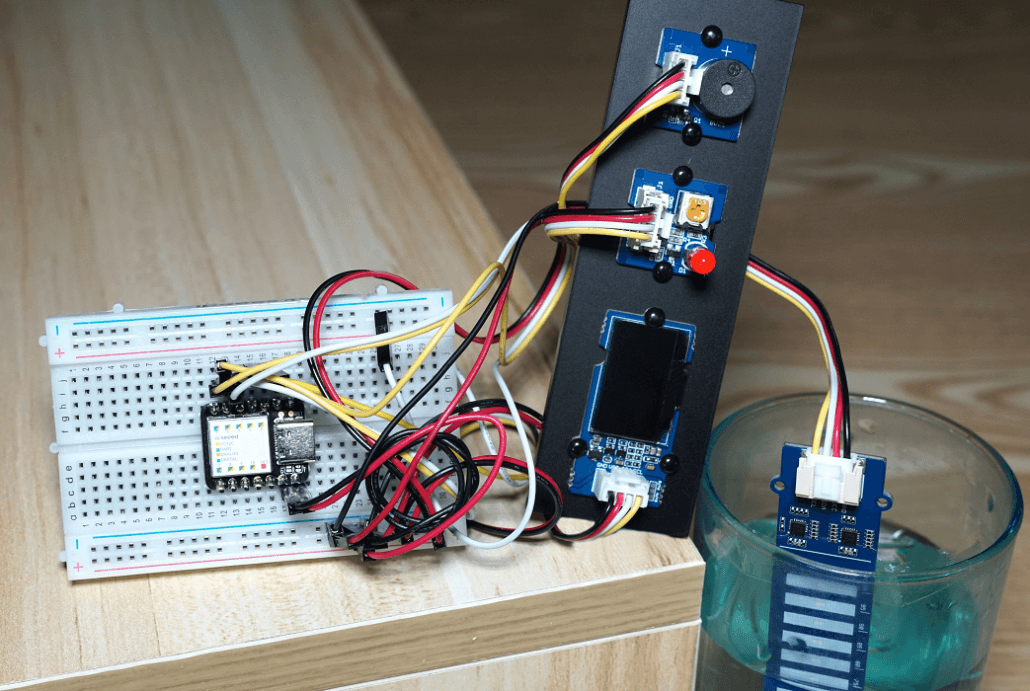
For this Arduino breadboard tutorial, we'll be sensing h2o level using the Seeeduino Xiao, the smallest Arduino board in the Seeeduino Family that's packed with SAMD21G18 and applicable for breadboard usage!
Hardware components needed:
- 1 Seeeduino Xiao
- i Breadboard
- 4 4-pin Male Jumper to Grove 4-pivot conversion cable
- 2 Dupont Jumper Wires
- 1 Grove – LED Pack
- i Grove – Buzzer
- 1 Grove – Water Level Sensor (10cm)
- 1 Grove – OLED Brandish 0.96″
Hardware associates and configurations:
- Step one: Insert Seeeduino XIAO into the breadboard, and reserve the wiring positions on both side. The row of each pin on the left and right is continued


- Stride two: Connect the iv-pin Male Jumper to Grove 4-pin Conversion Cable with Grove – Water Lever Sensor
- Base on the pinout in a higher place, connect the jumper side as follow:
| RED | 5v |
| Black | GND |
| WHITE | A0 |
| Yellow | A1 |
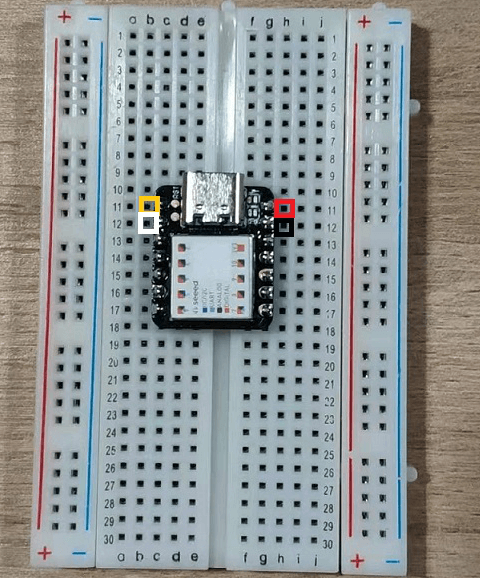
The Grove side of the cable is then connected to the Grove – Water Level Sensor
- Step iii: Apply the 4-pivot male jumper to Grove iv-pivot conversion cable and connect to OLED Display 0.96″. Since the Seeeduino Xiao is an I2C interface, SDA and SCL are used
- Connect the jumper side as follow:
| Cerise | 5V |
| Black | GND |
| WHITE | SDA |
| YELLOW | SCL |

The Grove side of the cable is then continued to the OLED Display 0.96″
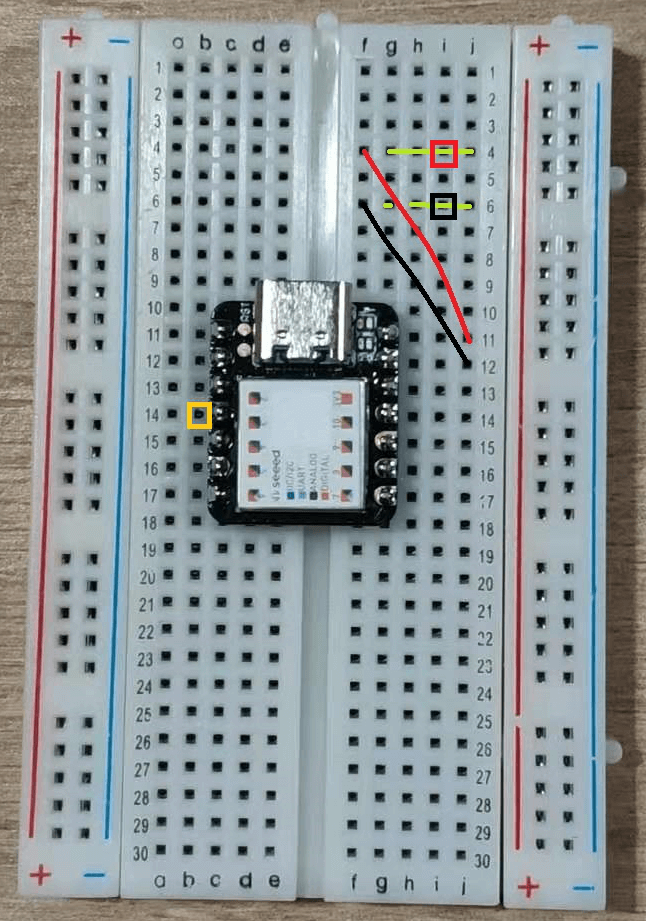
- Step 4: Use the 4-pin Male Jumper to Grove 4-Pin conversion cable to connect LED using D2 interface but as there's merely 1 interface left in each row of 5V and GND, we'll have to lead the line out and then that subsequent components can be used
- Use the Reddish and blackness wires to pb information technology to the position shown in the effigy, with:
- The yellow line in the fourth row are all continued to 5V
- The jacks covered by the yellowish line in the 6th row are all connected to GND
- Use the Reddish and blackness wires to pb information technology to the position shown in the effigy, with:
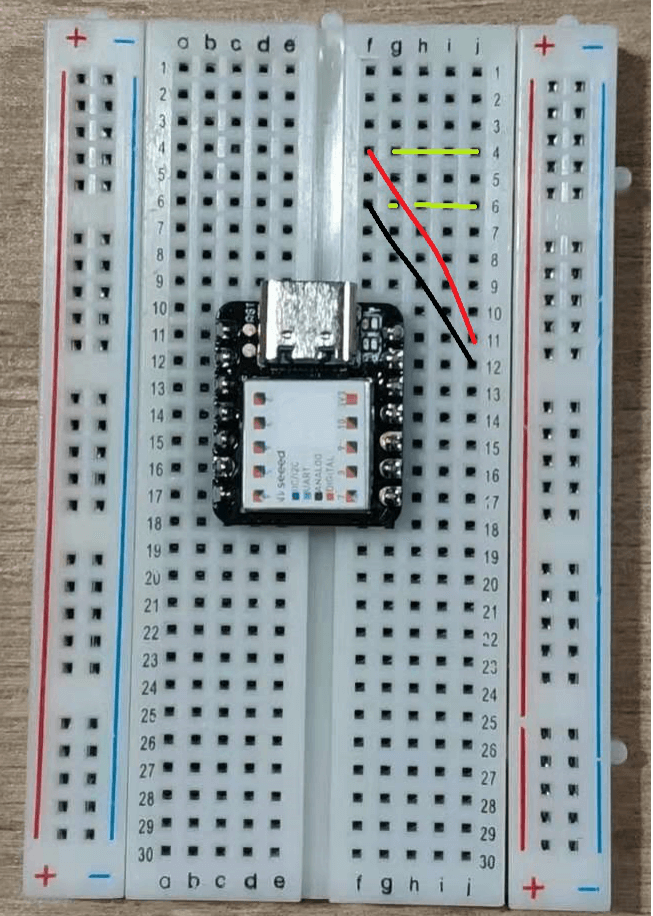
Now the lines are connected by:
| RED | Newly continued 5V |
| Black | Newly connected GND |
| YELLOW | D2 |
| WHITE | Not Connected |
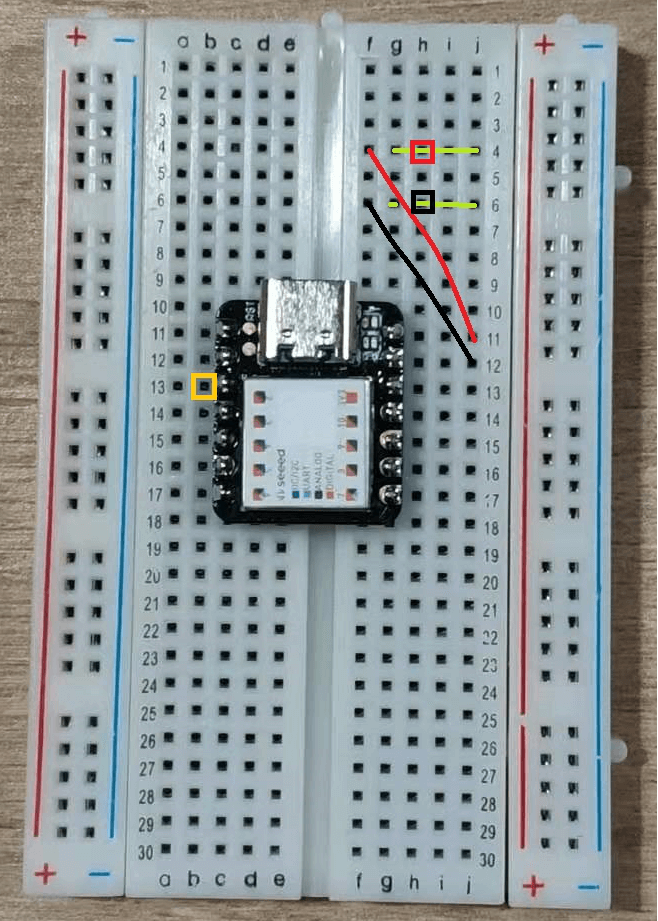
The Grove side of the cable is then connected to the LED pack
- Step 5: Apply the 4-Pin Male person Jumper to four-Pin Conversion Cable to connect the Buzzer, using the A3 port
The end of the jumper wire is connected as below:
| Cerise | Newly connected 5V |
| BLACK | Newly connected GND |
| YELLOW | A3 |
| WHITE | Not Continued |
The Grove side of the cable is then connected to the Buzzer
- Step six: Connect the Seeeduino Xiao to your PC via a Type-C cablevision
Software configurations and Arduino Code:
- Footstep 1: Open up up Arduino IDE, copy the following lawmaking and upload the lawmaking
- If you're unsure on how to upload the lawmaking, refer to our guide here
#include <Wire.h> #include <Arduino.h> #include <U8x8lib.h> U8X8_SSD1306_128X64_NONAME_SW_I2C u8x8(/* clock=*/ A0, /* information=*/ A1, /* reset=*/ U8X8_PIN_NONE); // Digispark ATTiny85 #ifdef ARDUINO_SAMD_VARIANT_COMPLIANCE #ascertain Series SerialUSB #else #define SERIAL Serial
0 Response to "How to Read the Rows for 100m"
Postar um comentário